If you can't explain a line on your CV, AI pushed it too far
One recruiter allows AI to organise and polish an application but bans inflating it. Ask three questions of every line to find the ones you have to rewrite.
“Do not use AI to inflate or invent your skills and experiences.” That line is on the candidate guidance page of Civil Service Careers, the recruitment site of the UK Civil Service. Right beside it is a list of what AI may help with: refining your ideas, checking spelling, and structuring examples you supplied yourself.
So asking AI to polish a CV is not treated as cheating. The line is drawn one sentence at a time. If, after AI has edited a line, you can no longer back it up with something you actually did, that line has been inflated, and it has to be cut or rewritten before you send the CV.
Where one employer drew the line
This is guidance from the UK Civil Service, not a rule set by any employer in Vietnam. It is used here because it spells out, item by item, what is allowed and what is not.
You may use AI to: refine and clarify your own ideas; research public information about the organisation you are applying to; check spelling, grammar and clarity; have AI pick out the skills the job advert asks for, then work out for yourself where you have shown them; write a list of your own examples and ask AI to help structure them.
You may not use AI to: inflate or invent skills and experience; create generic responses and copy them into your application; complete personality or ability tests; give an AI tool sensitive information about your organisation, such as figures or personal details.
The page also says candidates will be asked to confirm that the information they provide is true, and that applications may be rejected where AI is used inappropriately at any stage.
Notice the order in the examples the page counts as good use: you write the example first, and AI arranges it afterwards. Reverse that order, letting AI write an achievement that you then claim, and the CV starts to slide.
Try it on one line
The line you type: “Built an Excel file tracking orders for the sales team, updated every morning.” You ask a chatbot to make it sound more professional and get back: “Led the digital transformation of the sales process, boosting sales team productivity by 35%.” Both lines are examples made up by the editors for illustration.
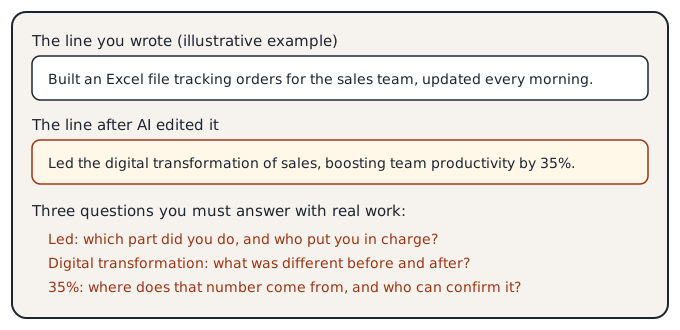
The new line sounds better. Now read it the way an interviewer will, and question each phrase:
- “Led”: were you put in charge, or did you build the file for yourself and the others started using it? If it was the second, “built” is more accurate than “led”.
- “Digital transformation”: before and after that Excel file, what changed in the way the team worked? If the answer is “everyone used to keep their own notebook, now the whole team looks at one shared file”, write exactly that.
- “35%”: where does that number come from? If you never had a figure, AI added it. Delete it. If you do have a real figure, such as how many orders a day the file tracked, use it and say what it counts.
A rewrite might read: “Built a shared order-tracking file for the sales team, so everyone could see which orders were late first thing in the morning.” It is shorter and less impressive, but you can keep talking about it for two minutes: why you made it, how, who used it, and what you fixed later.
Do the same with every line before you send the CV. Read each one out loud and ask yourself: which part did I do, what came of it, and who could confirm it? Any line where you hesitate is a line to fix.
Your old employer’s figures do not go into the chatbot
To put numbers on a CV, many people paste a whole revenue report, a customer list or a team pay sheet into a chatbot and ask it to “pull out my achievements”. The UK Civil Service guidance puts giving an AI tool your organisation’s figures and personal details on the list of things not to do. If you are still employed, that is also data belonging to the company you work for.
A safer way: write down yourself the numbers you are allowed to share, at the level of detail you are allowed to share them. “Handled about 40 business clients” instead of a list of client names. If you are not allowed to share a number, describe the work and leave the number out.
Practise for the interview beforehand, not with AI during it
The same guidance page allows AI for preparation: give a chatbot the job description, ask it for mock questions, then answer them yourself with your own examples. It does not allow AI to produce answers during an interview, including a pre-recorded one.
That practice session is also a second check on the CV. Ask the chatbot to press you on each line of your CV. Any question you can only answer by repeating the words on the CV points to a line that is not yet yours.
Why this is worth doing now
Microsoft’s 2026 Work Trend Index report for Vietnam, released on 24 June 2026, says 82% of AI users surveyed in Vietnam worry about falling behind if they do not adapt quickly to AI, compared with 65% globally. That pressure easily turns into a CV full of “led”, “optimised” and “transformed”. A CV where you can talk through every line may read as less polished, but it is a CV you can answer for when you are asked.
Sources
- A candidate’s guide to artificial intelligence (AI) in recruitment — Civil Service Careers (UK) — The list of acceptable and unacceptable uses of AI in applications and interviews for the UK Civil Service, including the bans on inflating experience and on giving sensitive organisational figures to AI tools, and the possibility of rejecting applications that use AI inappropriately.
- Work Trend Index 2026 report — Microsoft Asia, 24 June 2026 (in Vietnamese) — The Vietnamese-language press release says 82% of AI users surveyed in Vietnam worry about falling behind if they do not adapt quickly, compared with 65% globally.