A fluent line can drop the unless that was in the original letter
A smooth sentence in the language you read does not show that the original still has its condition, number, name, and date. Act only on what you can point to in the original.
The two sentences below were constructed by the editors. They are not the output of a translation tool that was just run.
The English letter says: “Please pay by Friday unless you have already cancelled.” A fluent line that someone might act on says only: “Please pay by Friday.” The fluent line is written in English here so you can see what dropped out. In a real letter, that fluent line would be the sentence in the language you actually read.
The fluent line sounds finished. It is missing “unless you have already cancelled,” which means you pay only if you have not already cancelled. A smooth sentence in the language you read does not show that the translation still has the original letter’s condition, number, name, and date. Act only on the part you can point to in the original.
A sentence that reads well and a sentence that still has its condition are different things
In the example, the shorter line is grammatical. A person who reads only that line can think they must pay in every case. A person who checks the original sees a narrower meaning: pay only if you have not cancelled. Lose one phrase and the action changes.
Machine translation and chatbots both choose a sentence that sounds plausible. That sentence can be fine for an ordinary note. It is not a version a fluent speaker has compared with the original. Google’s localization help page says Google Translate uses machine translation and can give good results for common topics. For short, context-dependent strings, using machine translation alone, without review by someone fluent in the target language, can cause errors when the text is used. That page is about wording in an app interface and in app-store descriptions. It does not give instructions for school letters or payment demands. The only part that carries over to a letter is that boundary: a machine-translated sentence that no person has reviewed is not yet a checked version.
Four things to point to in the original
Keep the original open beside you. In the constructed letter at the start, the deciding word is “unless.” The other three items are not in this sentence. When a real letter has them, you point the same way.
A proper name and an organization’s name have to keep the original spelling. If the original says Greenfield School and the translation says “Green Field School,” you do not yet know whether that is a translated name or a different place. When you reply, copy the name as it appears in the original.
An amount of money, a room number, a class period, and every other number have to sit in the original exactly as you are about to use them. If the translation adds an amount the original does not have, drop that amount. The opening example has no amount. If you still come away with a specific sum to pay, you added it. The letter did not say it.
A date and a deadline have to match the weekday or the calendar date the original writes. “Friday” is a weekday. It does not become a date on the calendar by itself. If the letter does not say 16 October, do not fill in 16 October and treat it as something the letter said.
Words that limit the scope — if, unless, except, only, not, before — have to remain in the sentence you rely on. In this example, “unless” is that word. Lose it, and the action changes from “pay if you have not cancelled” to “just pay.”
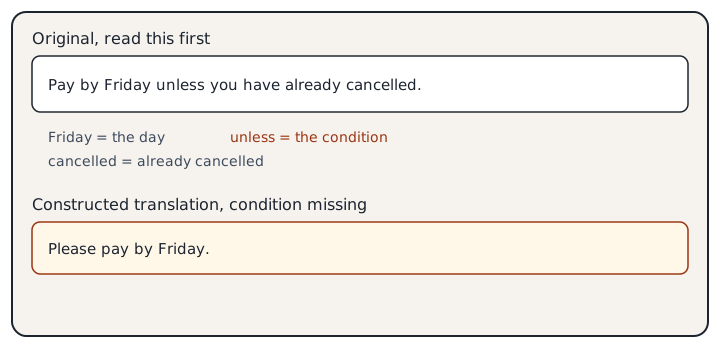
The diagram only reminds you of the order: original first, translation second, and use only the part you could point to. It is not the output of a translation tool.
A Vietnam survey says people translate. It does not say a translation is right
Decision Lab surveyed 600 internet users in Vietnam from 20 to 28 July 2025. In the learning-and-work group, 33% of AI users said they use AI to translate content. The same report has another 33% in the entertainment group, for practicing communication. The two figures are equal, and they are not the same task. The report does not measure whether a translated sentence keeps its conditions, and it does not separate a school letter from an ordinary message.
The survey is about internet users in Vietnam. It is not a global accuracy rate. 33% is a reason to treat translation with AI as something many people in that survey were already doing. It is not a reason to trust one particular sentence.
When to stop and ask a person
When a letter touches money, the cancellation of an agreement, or a signature, a fluent sentence is not enough to act on. Ask someone who can read the original, or ask the sender in the language of the letter: is the cancellation condition still there, what is the deadline, and what is the amount. If you cannot do that yet, do not reply and do not send the payment.
This rule does not say every machine-translated sentence drops the word “unless.” It also does not replace a version a responsible person has checked when the stakes are high. It keeps one narrow job: if you act on a condition, a number, a name, or a date, that item has to be in the original.
Primary sources
- Can I just use Google Translate to translate my app? — Google Localization Help — Google says machine translation can be fine for common topics, and that short, context-dependent interface strings can cause errors in use if a fluent speaker of the target language does not review them. The page does not give instructions for translating letters.
- The State of Consumer AI in Vietnam 2025 — Decision Lab — a survey of 600 internet users in Vietnam, 20–28 July 2025. In the learning-and-work group, 33% of AI users said they use AI to translate content. The survey does not measure whether a translation is correct.